
Real estate traditionally represents 20 to 30% of wealthy investors' portfolios. Yet acquiring physical property requires hundreds of thousands of francs and involves time-consuming management. Listed real estate ETFs and funds change the equation: with a few thousand francs, you gain access to diversified portfolios of commercial and residential buildings, without the constraints of property management.

This article analyses in depth the instruments available on Swiss, European and American markets. You will discover why Swiss real estate delivers a higher Sharpe ratio than equities, how to optimise a real estate allocation in your portfolio, and which strategies have historically generated the best risk-adjusted returns.
On the agenda: quantitative comparisons, 14-year backtests and empirically tested allocation strategies.
Table of Contents
- Basics of listed real estate ETFs and funds
- Advantages of investing via listed real estate ETFs and funds
- Types of listed real estate ETFs and funds
- Listed real estate funds
- ETFs composed of real estate companies
- Residential vs commercial real estate ETFs and funds
- Geographic overview of real estate ETFs and funds
- Key ETFs and listed real estate funds reviewed
- Industrial real estate
- Performance and risk analysis
- Portfolio integration strategies
- Swiss portfolio (equities + real estate)
- US portfolio (equities + real estate)
- US equities and Swiss real estate: the winning combination
- Swiss equities and US real estate
- More complex portfolios
- Conclusion: real estate as a pillar of a FIRE portfolio
- Frequently asked questions
- Sources and data
Basics of listed real estate ETFs and funds
Listed real estate ETFs and funds offer direct exposure to the performance of real estate indices, portfolios of listed property companies or groups of real estate assets. These instruments allow investors to participate in the property market without directly acquiring assets. They trade in real time on stock exchanges like shares, and their value fluctuates based on the underlying assets they represent. Those underlying assets can be broadly diversified or concentrated geographically and by sector.
Advantages of investing via listed real estate ETFs and funds
Accessibility is one of the main advantages: you can start with modest amounts compared to direct real estate investment. A single instrument can provide access to a wide range of properties spread across different geographies and sectors — a huge diversification advantage over direct investment, which typically concentrates on a single property.
Physical real estate is, by definition, difficult to liquidate quickly. Listed ETFs and funds mitigate this constraint by offering a decisive advantage: liquidity. You can buy or sell in seconds, just like any share.
Types of listed real estate ETFs and funds
It is important to distinguish listed real estate funds (which directly own properties) from ETFs composed of real estate companies (which hold shares in listed property firms). Within both categories, instruments may specialise in specific segments (residential or commercial) or particular geographic markets.
Listed real estate funds
Listed real estate funds directly own, operate or finance income-generating real estate. They provide access to diversified property portfolios without direct purchases and are generally less volatile than the stock market as a whole.
ETFs composed of real estate companies
These ETFs reflect a basket of shares of companies operating in the real estate sector. They are directly affected by the results of the companies they contain, which explains their generally higher volatility compared to listed real estate funds.
Residential vs commercial real estate ETFs and funds
Residential ETFs and funds offer more stable and predictable returns. Housing demand remains relatively constant even during economic slowdowns, which limits significant fluctuations. Their low correlation with economic activity provides welcome stability in a diversified portfolio. Commercial ETFs and funds — covering offices, shops and warehouses — tend to be more sensitive to the economic cycle: they benefit from rising rents and strong demand during expansions, but can experience significant value declines during recessions.
Geographic overview of real estate ETFs and funds
Swiss real estate
Swiss real estate benefits from solid political stability, a reliable legal framework and strong demand in major cities such as Zurich, Geneva and Basel. The strength of the Swiss franc attracts many foreign investors, while favourable interest rates have historically supported credit access. Economic growth and sustained immigration fuel housing demand. These factors are directly reflected in the results of Swiss ETFs and funds, which display relatively consistent returns combined with measured volatility.
European real estate
European real estate shows great disparities across countries, driven by very different economic policies and demographic conditions. Unlike Switzerland, instruments tradeable on European exchanges are primarily ETFs based on listed real estate companies, making them generally more volatile than their Swiss counterparts. French SCPIs (civil real estate investment companies), for example, are not listed on the stock exchange.
US real estate
US real estate ETFs are characterised by high returns accompanied by significant volatility. The American property market is vast and diversified, but highly sensitive to economic cycles. The 2008 crisis was the most striking illustration: the collapse in property prices caused significant losses on ETFs heavily exposed to mortgage-backed assets. The market has nonetheless shown long-term resilience, gradually recovering with the economic recovery.
Key ETFs and listed real estate funds reviewed
Switzerland: SRFCHA and SRECHA
On the Swiss stock exchange, two well-known ETFs cover the Swiss property market: SRECHA (SXI Real Estate Funds) and SRFCHA (SXI Real Estate). SRFCHA displays lower volatility than SRECHA, with slightly superior performance.
Among the constituents of SRFCHA, SIMA (UBS) stands out — invested roughly 50% in residential buildings and 50% in commercial properties, primarily in German-speaking Switzerland. It is the largest real estate fund in Switzerland, also listed on the Swiss exchange. ANFO, another listed UBS fund, focuses mainly on residential real estate in German-speaking Switzerland.
As SRFCHA tracks the broader SXI Real Estate index, it also includes listed real estate companies such as Swiss Prime Site and PSP Swiss Property — unlike SRECHA, which is composed exclusively of real estate investment funds.

The performance above reflects price return only — dividends are not included (more on this in the backtests section). There is also a UBS ETF dedicated exclusively to Swiss commercial real estate: Swissreal (SREA). Its performance is disappointing, however, significantly trailing its benchmark index (SRCHA).
In Switzerland, ETFs are generally less varied than in Ireland or the United States. On the other hand, the country offers a considerable choice of quality listed real estate funds. I personally favour listed real estate investment funds, which offer a slightly more favourable return/risk ratio. One can select individual funds such as ANFO or SIMA, or invest directly in the SRFCHA ETF which groups them together. My Determinant Portfolio (members area) includes several other listed funds not covered here.
I have always maintained that SRFCHA is an essential choice for any new investor, even before exploring equities. This ETF allows you to become familiar with how the stock exchange works with a volatility suited to beginners, while building a diversified portfolio at moderate risk.
Europe: IPRP
An accessible way to enter the European property market is to invest in the IPRP ETF from iShares. Although long-term profitability is satisfactory, its volatility is particularly high, due to its exposure to listed real estate companies such as Vonovia, Covivio, Klepierre, Castellum, Icade and Argan. IPRP also includes Swiss companies, making it possible to gain exposure to all these markets with a single instrument. However, combining the two ETFs adds little diversification value. European real estate has suffered from the inflation triggered by the 2021-2022 shocks and the subsequent rate hikes. In Switzerland, thanks to the strong franc, this phenomenon was far less pronounced.

United States: VNQ, REZ and beyond
In the United States, a wide range of real estate ETFs exists. VNQ from Vanguard is by far the most renowned and liquid, covering listed real estate companies in both residential and commercial sectors. Over the long term, VNQ shows interesting profitability, but its volatility remains high — particularly during the 2008 subprime crisis. Despite significant recovery since then, VNQ's performance does not match that of Swiss real estate represented by SIMA, which also displays far lower volatility — especially given that the dollar has lost value against the Swiss franc over this period.

Among VNQ's components, Realty Income (ticker: O) deserves special mention. Founded in 1969 and self-branded as "The Monthly Dividend Company", Realty Income operates in commercial real estate (retail chains, pharmacies, fast food) across the US, UK, France, Spain, Portugal, Italy, Ireland and Germany. Its focus on defensive sectors allowed it to navigate the 2008 crisis far more serenely than its American peers. Realty Income even outperforms SIMA, accounting for the dollar's decline. One important caveat: "O" is a listed real estate company, while SIMA is a listed real estate investment fund — the risks are not comparable.

Another US ETF worth attention is REZ from iShares. Despite its evocative name, less than half its capitalisation is truly residential: it replicates an index of US real estate company shares in residential, healthcare and self-storage sectors, giving it a more defensive profile. Between 2010 and 2024, REZ substantially outperformed VNQ.
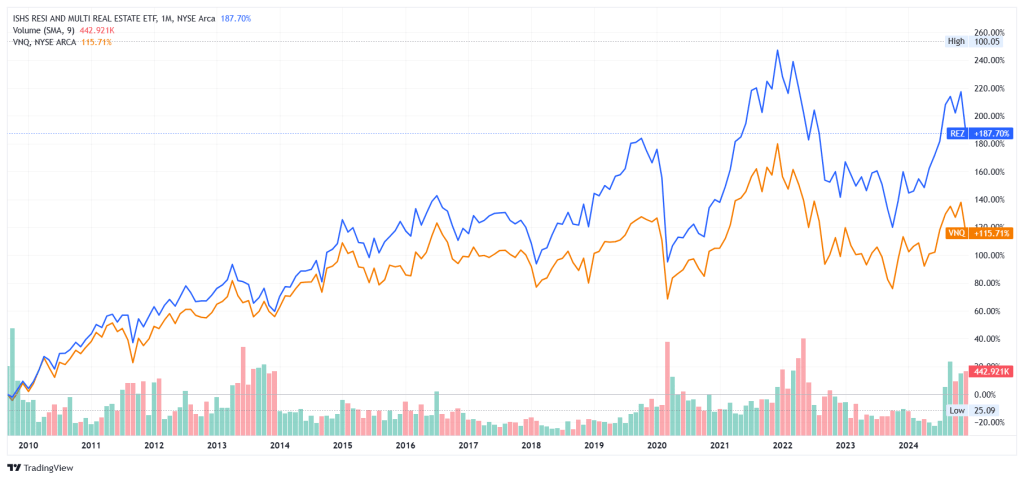
Global: REET
For global exposure, iShares' REET ETF is an option to consider — with caution. The US component represents 75% of the instrument, 80% oriented toward commercial real estate. Between 2014 and 2024, REET significantly underperformed VNQ. Global diversification does not compensate for the weight of US commercial real estate here.

Industrial real estate
Manufacturing and logistics companies are increasingly externalising their real estate needs — light production facilities, warehouses, distribution centres. This dynamic benefits companies specialising in industrial real estate, which lease their properties through long-term contracts. In the US and UK, these contracts are often "triple net": the tenant agrees to pay the base rent, maintenance and other costs related to the lease.
The boom in online sales drives growing demand for storage space. Supply chain disruptions push many companies to lease additional surface area to manage extra stock. Industrial real estate companies generate more stable cash flows than other commercial real estate players, thanks to long-term triple-net leases and low operating costs. The main risk is overcapacity: to quickly meet demand, these companies anticipate construction and acquisition of new capacity without signed leases, which can heavily weigh on revenues if occupancy is insufficient.
Prologis (PLD) is a global industrial real estate giant and the largest capitalisation in VNQ. This Californian company serves more than 6'700 customers across 19 countries, covering 111.5 km² of floor space — equivalent to nearly 16'000 football pitches. STAG Industrial (STAG) holds a diversified portfolio of industrial real estate (warehouses, light manufacturing, flexible spaces and offices) across multiple markets and industries, with nearly 600 buildings totalling more than 10.6 km². Like Realty Income, STAG pays monthly dividends. Argan (ARG) is a French property company specialising in the development and leasing of logistics platforms, with around a hundred sites covering 3.6 km².

Performance and risk analysis
Real estate investment performance is influenced by interest rates, inflation and economic cycles. Correlation with the equity market is one of the main drawbacks of this asset class, as it limits diversification benefits during major financial crises. Among all instruments analysed, only Swiss listed real estate funds appear partially spared from these phenomena.
| Switzerland | USA | Commercial real estate stocks | ||||||
|---|---|---|---|---|---|---|---|---|
| Since April 2011 in CHF (Total Return) | SRFCHA | SRECHA | VNQ | REZ | O | STAG | PLD | ARG |
| Annualized Return (%) | 5.51 | 5.08 | 7.09 | 8.21 | 8.03 | 13.84 | 10.24 | 12.72 |
| Max Drawdown (%) | -22.82 | -24.3 | -42.27 | -44.07 | -48.84 | -51.41 | -45.58 | -51.41 |
| Standard Deviation (%) | 8.1 | 7.87 | 16.49 | 17.15 | 21.03 | 22.54 | 23.43 | 22.54 |
| Sharpe Ratio | 0.61 | 0.59 | 0.51 | 0.56 | 0.49 | 0.67 | 0.56 | 0.67 |
| Correlation with S&P 500 | 0.31 | 0.31 | 0.71 | 0.58 | 0.41 | 0.41 | 0.62 | 0.41 |
| Beta | 0.17 | 0.16 | 0.81 | 0.69 | 0.59 | 0.95 | 1.01 | 0.64 |
Key findings: SRFCHA and SRECHA are neck and neck — SRFCHA holds a marginal edge in profitability, Sharpe ratio and maximum loss, but the difference is minimal. Swiss real estate is clearly the least risky: contained maximum loss, low volatility, low correlation with the S&P 500 and low beta. Despite a slightly lower CAGR than other instruments, it delivers a very good Sharpe ratio. In the US, REZ shows better overall results than VNQ: higher CAGR and Sharpe ratio, lower market correlation and lower beta.
Portfolio integration strategies
Swiss real estate via an ETF like SRFCHA can be an excellent choice for someone taking their first steps in investing. Few investments return more than 5% per year in CHF on average with a volatility of only 8%. Real estate can also integrate into a multi-asset portfolio: Swiss listed real estate funds are lowly correlated to the S&P 500, which makes them capable of providing interesting diversification within an equity portfolio. All portfolios below were backtested with annual rebalancing.
Swiss portfolio (equities + real estate)
A 100% Swiss real estate allocation delivers a better Sharpe ratio than a pure equity investment. At equivalent risk, it is therefore preferable to invest in Swiss real estate. This confirms SRFCHA as the preferred instrument in a single-ETF strategy. Nevertheless, combining both asset classes proves even more advantageous.
| Backtest 2011-2024 (CHF) | CAGR (%) | Sharpe |
|---|---|---|
| EWL | 6.63 | 0.55 |
| 85% EWL + 15% SRFCHA | 6.54 | 0.59 |
| 45% EWL + 55% SRFCHA | 6.22 | 0.69 |
| SRFCHA | 5.63 | 0.61 |
The sweet spot in terms of return/risk sits near parity, at around 45% equities and 55% real estate. This departs significantly from conventional recommendations (5 to 15% for real estate). There is indeed a Swiss Sonderfall around real estate, explained by the structural reasons covered throughout this article.
US portfolio (equities + real estate)
Things look very different on the other side of the Atlantic. US equities significantly outperform real estate, with a considerably higher Sharpe ratio. Combining the two asset classes generates no additional value due to their relatively high correlation. This is also observed with REZ, despite its lower market link than VNQ.
| Backtest 2011-2024 (CHF) | CAGR (%) | Sharpe |
|---|---|---|
| SPY | 13.41 | 0.93 |
| 85% SPY + 15% REZ | 12.75 | 0.93 |
| 75% SPY + 25% REZ | 12.28 | 0.91 |
| REZ | 8.21 | 0.56 |
With a 15% real estate allocation, the portfolio shows a Sharpe ratio equal to a pure SPY strategy, but with lower profitability. Note that the period studied does not include the subprime crisis — results would have been even less favourable. A portfolio composed solely of SPY proves more efficient in this context.
US equities and Swiss real estate: the winning combination
This is where things become particularly interesting. Combining US equities with Swiss real estate sacrifices some profitability but considerably reduces portfolio volatility, translating into a significantly better Sharpe ratio. The optimal allocation sits at around 60% US equities and 40% Swiss real estate.
| Backtest 2011-2024 (CHF) | CAGR (%) | Sharpe |
|---|---|---|
| 85% SPY + 15% SRFCHA | 12.36 | 0.96 |
| 60% SPY + 40% SRFCHA | 10.45 | 0.98 |
A Sharpe ratio of 1.01 for a 60% SPY / 40% SRFCHA allocation versus 0.51 for pure SPY is a remarkable result. For FIRE investors, this is decisive: a less volatile portfolio allows a higher withdrawal rate while reducing the risk of capital depletion.
Swiss equities and US real estate
Out of curiosity, I explored the opposite approach: mixing Swiss equities with US real estate. One might expect disappointing results given EWL's limited profitability and REZ's high volatility. Yet the combination offers a better Sharpe ratio than either ETF individually. The sweet spot sits at 60% Swiss equities and 40% US real estate — though performance remains significantly below the SPY + SRFCHA strategy.
| Backtest 2011-2024 (CHF) | CAGR (%) | Sharpe |
|---|---|---|
| 85% EWL + 15% REZ | 7.08 | 0.61 |
| 60% EWL + 40% REZ | 7.66 | 0.65 |
More complex portfolios
Rather than investing in all Swiss real estate via SRFCHA, one can focus on a selection of its constituent funds ("Swiss RE" in the tables below). This is the approach I take in my Determinant Portfolio, which pushes the CAGR and Sharpe ratio somewhat further. In the same vein, replacing SPY with the three-ETF triad (QQQ + VDC + XLV) adds a few more basis points, reaching a return of 11.23%/year on average with an excellent Sharpe ratio of 1.15.
| Backtest 2011-2024 (CHF) | CAGR (%) | Sharpe |
|---|---|---|
| 60% SPY + 40% Swiss RE selection | 10.86 | 1.01 |
| 20% QQQ + 20% VDC + 20% XLV + 40% SRFCHA | 10.78 | 1.11 |
| 20% QQQ + 20% VDC + 20% XLV + 40% Swiss RE selection | 11.23 | 1.15 |
The same approach can be applied using international commercial real estate (O, STAG, PLD, ARG) alongside SPY. Results are impressive from a CAGR standpoint, but less so for the Sharpe ratio — even breaking SPY into three ETFs and adding Swiss real estate cannot reach the 1.15 Sharpe ratio. Moreover, past performance is not a guarantee of future results — even more true at the level of individual securities like PLD, O, STAG and ARG.
| Backtest 2011-2024 (CHF) | CAGR (%) | Sharpe |
|---|---|---|
| 60% SPY + 10% O + 10% STAG + 10% PLD + 10% ARG | 13.52 | 0.95 |
| 20% QQQ + 20% VDC + 20% XLV + 10% O + 10% STAG + 10% PLD + 10% ARG | 13.67 | 1.03 |
| 20% QQQ + 20% VDC + 20% XLV + 5% O + 5% STAG + 5% PLD + 5% ARG + 20% Swiss RE | 12.66 | 1.10 |
Conclusion: real estate as a pillar of a FIRE portfolio
Listed real estate ETFs and funds transform a traditionally illiquid asset class into flexible, accessible instruments. Our quantitative analyses demonstrate that Swiss real estate — particularly via SRFCHA — is an exceptional asset for optimising a portfolio's return/risk profile.
Key takeaways: Swiss real estate delivers the best Sharpe ratio among all markets analysed (0.65 vs 0.51 for the S&P 500). A 60% US equities / 40% Swiss real estate allocation generates a Sharpe ratio of 1.01, superior to a 100% equity portfolio. Contrary to conventional wisdom, a real estate allocation of 40 to 55% can be optimal when using Swiss instruments. The investment horizon required for Swiss real estate is roughly half that needed for equities.
For investors on the path to financial independence, this combination offers a decisive advantage: a less volatile portfolio allows a higher withdrawal rate while reducing the risk of capital depletion. The VPW method (Variable Percentage Withdrawal) fully exploits this advantage, adapting the withdrawal rate each year based on age, portfolio allocation and actual results — a far more robust approach than the 4% rule, which remains a useful but one-size-fits-all approximation.
Frequently asked questions
What percentage of real estate should a diversified portfolio hold?
Traditional recommendations suggest 5 to 15% real estate. Our backtests show that for Swiss real estate combined with US equities, the optimal allocation sits around 40% real estate and 60% equities, generating a superior Sharpe ratio. This atypical allocation is explained by the low volatility and low correlation of Swiss real estate with equity markets — a structural characteristic that does not apply to US or European real estate.
Do real estate ETFs pay dividends?
Yes, most ETFs and real estate funds distribute regular dividends, often quarterly or annually. Certain companies such as Realty Income (O) and STAG Industrial even pay monthly dividends. Swiss real estate funds display distribution yields of between 3% and 4% annually.
Does real estate protect against inflation?
Partially. Commercial real estate generally benefits from rent indexation clauses. However, rising interest rates (used to combat inflation) negatively impact the valuation of real estate assets. Swiss real estate funds weathered post-2021 inflation better than their European and American counterparts, thanks to the stability of the Swiss franc.
What are the main risks of real estate ETFs?
The main risks are sensitivity to interest rate changes, high correlation with equity markets during major crises (except for Swiss real estate), economic cycles affecting rental demand, and share price volatility. ETFs based on real estate companies (such as IPRP) are more volatile than funds directly holding properties (such as SRFCHA).
SRFCHA or SRECHA: which to choose?
SRFCHA (SXI Real Estate ETF, mixed: listed real estate investment funds and property companies) displays slightly lower volatility and a marginally superior Sharpe ratio to SRECHA. The difference remains minimal. SRFCHA better suits investors seeking maximum stability. For the most practical approach, SRFCHA is the default choice for any Swiss or Europe-based investor building a FIRE portfolio.
Sources and data
- SIX Swiss Exchange – historical data SRECHA, SRFCHA, SIMA, ANFO, SREA: six-group.com
- iShares by BlackRock – IPRP and REET product pages: ishares.com
- Vanguard – VNQ product page: vanguard.com
- iShares – REZ product page: ishares.com
- Realty Income Corporation: realtyincome.com
- Prologis – Annual Report 2024: prologis.com
- STAG Industrial – Investor Relations: ir.stagindustrial.com
- Argan SA – Investor Relations: argan.fr
- Performance data and ratios: FactSet
En savoir plus sur dividendes
Subscribe to get the latest posts sent to your email.